Section
Quick Answer
Set your refrigerator to 37°F (3°C) and your freezer to 0°F (-18°C) — the standard food-safety recommended settings. Most fridge controls are numbered 1 to 9 rather than marked in degrees, so the only accurate way to confirm the real temperature is an appliance thermometer left inside for several hours.
- Fridge: 37°F (3°C) — safe range 35–40°F
- Freezer: 0°F (-18°C)
- Dial numbers are not degrees — higher just means colder
- Still wrong a day later? A component fault, not a setting
The Ideal Fridge and Freezer Temperature
The recommended refrigerator temperature is 37°F (3°C) and the recommended freezer temperature is 0°F (-18°C). Bacteria multiply quickly above 40°F (4°C), while below roughly 32°F (0°C) the water inside fresh produce and dairy begins to freeze and ruin the texture. 37°F sits in the middle of that narrow window.
| Zone | Recommended | What to Expect |
|---|---|---|
| Refrigerator shelves | 37°F / 3°C | Safe range 35–40°F (2–4°C) |
| Freezer | 0°F / -18°C | Ice cream firm, no soft spots |
| Door shelves | — | Warmest zone — keep milk and eggs on a shelf |
Why the Dial Numbers Don't Tell You the Temperature
Many refrigerators use a dial marked 1 through 9, or a slider labelled Cold / Colder / Coldest. Those markings are not degrees — they set how hard the cooling system runs, and the result depends on the room the fridge sits in, how full it is, and how often the door opens. A "5" in a cool basement and a "5" in a warm July kitchen are two different temperatures.
Higher means colder on almost every brand, but there is no universal mapping to degrees. Even a digital model showing 37 displays a target, not a measurement.
How to Check Your Fridge Temperature Accurately
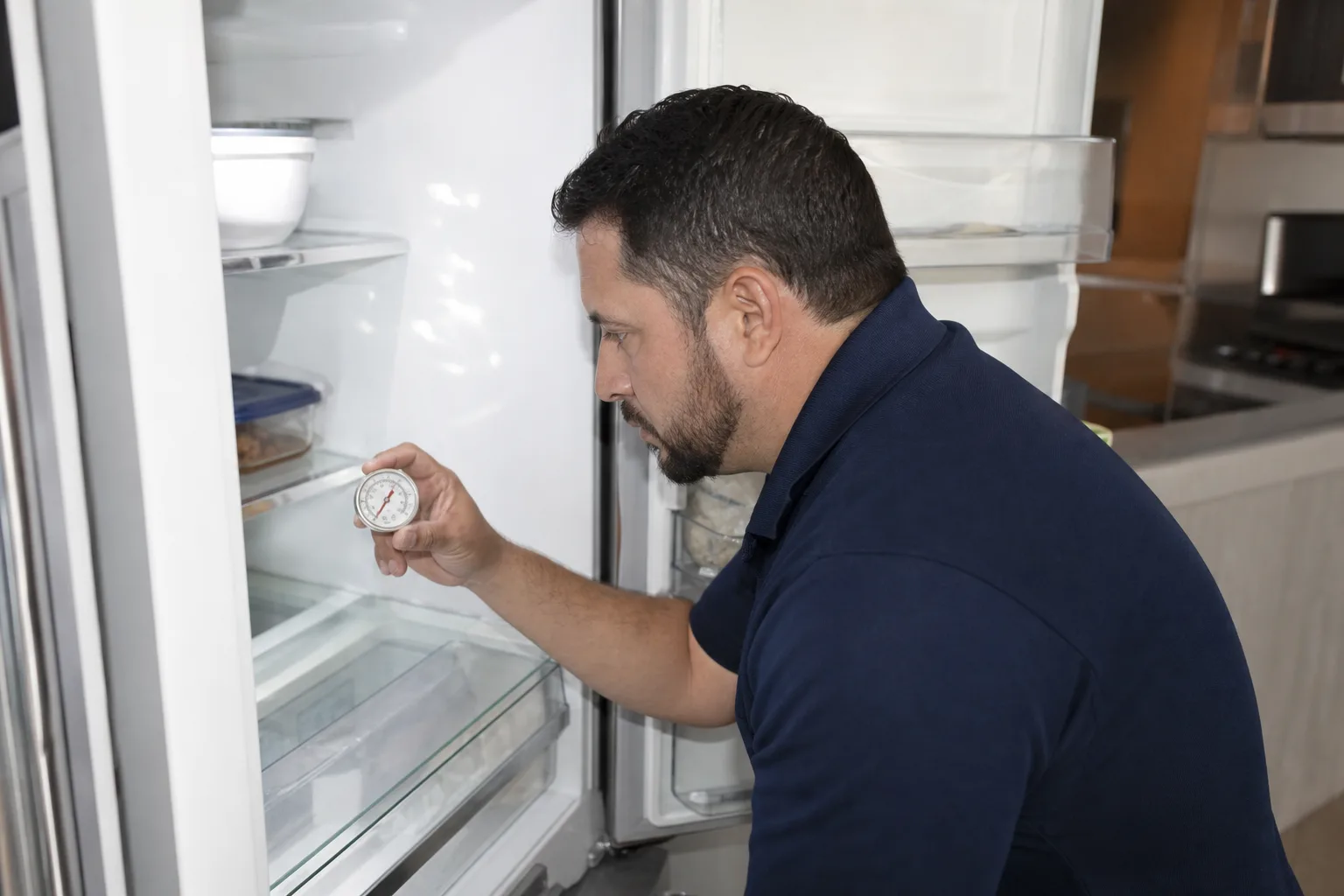
You need a separate appliance thermometer, about $10–$15 at any hardware store. Do not measure the air — it swings several degrees every time the door opens. Measuring a liquid instead shows what your food is genuinely held at.
The Accurate Temperature Test
How to Adjust the Setting
Dial and Slider Models
Move the control one number at a time and give it a full 24 hours to stabilise. If your test showed 42°F, go from 4 to 5 and re-test tomorrow. Jumping from 3 to 8 overshoots and starts freezing the produce at the back.
Digital Display Models
Set the target directly: 37 and 0 in Fahrenheit, or 3 and -18 in Celsius — check which unit your model uses, because mixing them up produces a wildly wrong setting. If the buttons do nothing, hold the control-lock button first.
What It Means When the Temperature Is Off
1 Food Is Freezing in the Fridge Compartment Maybe DIY
Ice crystals in the lettuce, slushy milk at the back of a shelf. Rule out the cheap explanation first: the thermostat is set too cold. Step the dial down one number and re-test tomorrow.
A blocked air vent or damper. Cold air reaches the fridge compartment through vents on the back wall. A tall container pressed against one blasts freezing air onto whatever sits beside it, so keep everything a couple of centimetres clear. If food still freezes at the lowest setting with clear vents, the thermostat or damper control has failed — see refrigerator freezing food.
2 Food Spoils Faster Than Normal Maybe DIY
Milk turning days early, greens wilting in three days, condensation on the shelves — while the setting looks normal. The setting is the target; the fridge is failing to hold it. Three causes account for most of these:
- A worn or dirty door gasket. Close a dollar bill in the door and pull. If it slides out with almost no resistance, the seal is weak there. Wash the gasket first — residue alone often stops rubber sealing.
- Dirty condenser coils. Packed with dust and pet hair, they cannot shed heat and the interior drifts warmer. Unplug the fridge and vacuum them: how to clean refrigerator coils.
- A failing evaporator or condenser fan motor. Temperatures climb although nothing about the setting changed, usually with clicking or buzzing first. A professional repair: refrigerator making a buzzing noise.
When a Setting Change Won't Fix It
If your thermometer still reads outside 35–40°F a full 24 hours after you corrected the setting, this is no longer a settings problem.
What a technician checks next: thermostat or thermistor accuracy, the damper control between compartments, the evaporator and condenser fan motors, the defrost heater and timer, the start relay, the control board, and the door gaskets.
The pattern helps: a gradual drift over months points at coils, gaskets, or a tiring fan motor; a sudden collapse over a day or two points at an electrical component.
$89 Diagnostic — Waived with Repair, plus $40 OFF any repair and a 90-day warranty on parts and labour. Most repairs run $150–$350. Book online or call (437) 747-6737.
Frequently Asked Questions
The recommended refrigerator temperature is 37°F (3°C) and the recommended freezer temperature is 0°F (-18°C) — the standard food-safety recommended settings. Above 40°F (4°C) bacteria multiply quickly, and below about 32°F (0°C) fresh food starts to freeze and lose its texture.
There is no universal answer, because the numbers on a 1–9 dial are not degrees. Higher means colder on nearly every brand. Start in the middle, wait 24 hours, then measure the real shelf temperature with a thermometer and adjust one step at a time.
Either the thermostat is set too cold, or something is blocking an air vent. Cold air enters through vents on the back wall, and a tall container parked against one blasts freezing air onto whatever sits beside it. Clear the vents and step the dial down one number.
The setting is a target, not a guarantee. A worn or dirty door gasket lets warm room air in, dusty condenser coils stop the fridge shedding heat, and a weakening evaporator or condenser fan motor kills airflow. Test the seal and vacuum the coils first.
Often, yes. A dial setting is not a temperature, so the same number gives a warmer fridge in a hot GTA kitchen in July than in February. Re-test in early summer, and if the shelf temperature has drifted above 40°F (4°C), move the dial one step colder.