Section
Quick Answer
Most induction cooktops that will not heat are not broken. The usual causes are cookware that is not magnetic, a pot too small or off-centre, an active child lock, or a tripped breaker on the dedicated 240V circuit. Run those four checks first; a dead panel or failed coil needs a technician.
- #1 cause: non-magnetic cookware — check with a fridge magnet
- #2 cause: pan too small or off-centre for the zone
- #3 cause: control lock / child lock left on
- #4 cause: tripped breaker on the dedicated 240V supply
- Repair costs: $150–$350; $89 Diagnostic — Waived with Repair
Induction is the fastest-growing electric cooking category in Canadian kitchens, and our technicians see it in renovated GTA condos every week. It is also the appliance most often reported as broken when nothing has failed. Here are the causes in the order a technician checks them.
How Induction Heating Actually Works
An induction cooktop is fully electric. Under the glass sits a coil of wire, and switching a zone on creates a rapidly alternating magnetic field. That field does nothing to the glass or the air — it induces a current directly in the base of a magnetic pan, and the pan heats itself.
Two consequences explain most complaints. If the pan is not magnetic there is nothing for the field to act on, so the zone stays cold. And sensors must confirm a suitable pan is present and centred, or the zone will not power at all.
Top 7 Causes of an Induction Cooktop Not Heating
1 Cookware Is Not Induction-Compatible DIY
By far the most common call. Induction needs a ferromagnetic base: cast iron, enamelled cast iron and magnetic stainless steel work; aluminum, copper, glass and most ceramic never heat.
Symptoms: The display responds but the pan stays cold; some models flash a pan-detection symbol and shut the zone off.
Fix: Hold a fridge magnet to the pan base. A firm grip means it will heat. Trust the magnet, not the box.
2 Pan Too Small or Off-Centre DIY
Each zone has a minimum base diameter, and the sensor needs the pan to cover most of the ring. A small espresso pot on a large zone often will not register.
Symptoms: Larger pans heat fine on the same zone; the small pan gives no heat or cuts out after seconds.
Fix: Move to a smaller zone and centre the pan in the printed ring. Warped bases that rock also break detection.
3 Control Lock or Child Lock Is On DIY
Nearly every induction cooktop has a lock that disables the entire touch panel, and it is easy to trigger while wiping the glass.
Symptoms: The cooktop has power and the display lights up, but no zone responds; a padlock or key symbol is showing.
Fix: Press and hold that symbol for three to five seconds until it clears. Some brands need two pads held together.
4 Power Supply Problem on the 240V Circuit Maybe DIY
An induction cooktop draws serious current on its own dedicated 240V circuit. Lose one leg of that supply and half the cooktop can die while the rest works.
Symptoms: The whole surface dead, or half the zones working; a breaker sitting between on and off.
Fix: Reset the double-pole breaker fully off, then on. If it trips again, leave it off — a loose connection behind the unit is technician or electrician work.
5 Overheat Protection Has Shut the Zone Down Normal
Sensors under the glass monitor temperature, and if a pan boils dry the cooktop cuts that zone until it cools. This is a safety feature working correctly, not a failure.
Symptoms: A zone quits mid-cook after very high heat; the surface is extremely hot; it works again once cool.
Fix: Remove the pan and let the surface cool, and check the vents below are clear. Frequent shutdowns during ordinary cooking mean a failing sensor or fan.
6 Failed Control Board or Touch Panel Professional
The control board reads your touch input and switches power to the coils. When it or the touch panel fails, the cooktop ignores you even with power confirmed.
Symptoms: Display dead or flickering; pads ignoring input or registering phantom presses; error codes; settings changing on their own.
Fix: Diagnosis and replacement by a certified technician, typically $200–$350.
7 Induction Coil or Sensor Failure Professional
Least common, but real after years of service. Each zone has its own coil and sensor, so when one fails that zone stops heating while the rest behaves normally.
Symptoms: One zone dead with proven magnetic cookware and no lock active; an error code for that zone only.
Fix: Coil or sensor replacement by a certified technician, typically $150–$300.
Before Calling a Technician, Try These:
Stop if the glass is cracked. A chipped or cracked surface should not be used even if the zones still heat — liquid reaching the coils underneath is a shock and short-circuit risk. Switch off at the breaker and book a diagnosis.
Induction Cooktop Repair Costs (Toronto & GTA)
| Issue | DIY Possible? | Pro Repair Cost |
|---|---|---|
| Incompatible or undersized cookware | Yes — $0 | No repair needed |
| Control lock left engaged | Yes — $0 | No repair needed |
| Wiring or connection fault | Breaker only | $150 – $250 |
| Induction coil or sensor | No | $150 – $300 |
| Control board or touch panel | No | $200 – $350 |
All prices include parts and labour, and typical repairs run $150–$350.
$89 Diagnostic — Waived with Repair. We are also running a limited-time $40 OFF any repair. Book online or call (437) 747-6737.
When to Call a Technician
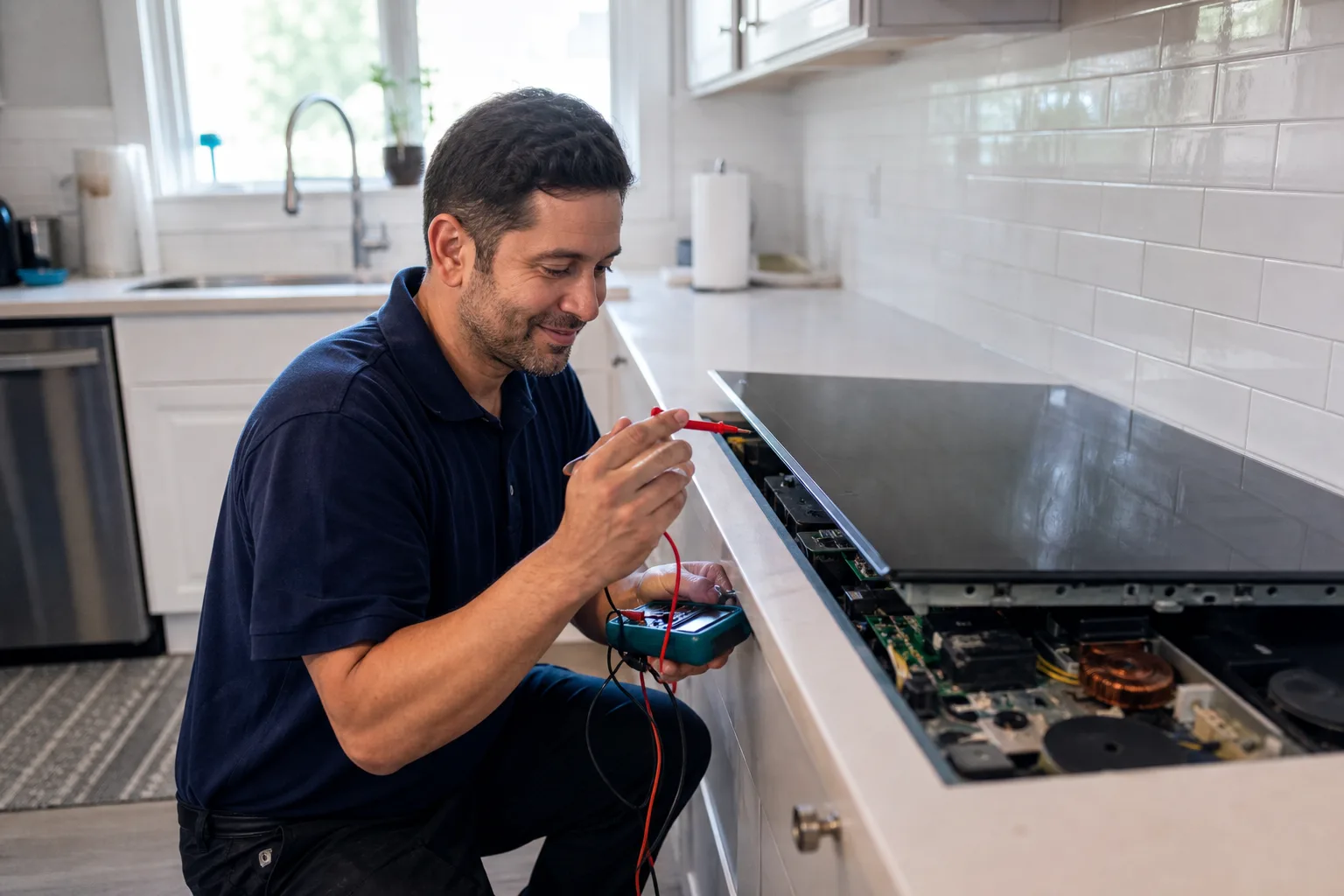
Work through the checklist first — it resolves most not-heating calls at no cost. Book a diagnosis when the cooktop is dead with the breaker confirmed on, when one zone stays dead with proven magnetic cookware, or when error codes keep returning after a reset.
Frequently Asked Questions
Hold a fridge magnet against the bottom of the pan. A firm grip means it will heat; if it slides off, it will not. Cast iron, enamelled cast iron and magnetic stainless steel work. Plain aluminum, copper, glass and most ceramic pans do nothing at all on induction.
That is usually overheat protection doing its job. If a pan boils dry or runs empty at high power, the sensor under the glass reads excess heat and shuts that zone down until it cools. Repeated shutdowns during normal cooking point to a sensor or fan problem.
Check the control lock first. Almost every model has a padlock or key symbol that disables the whole touch panel, and it is easy to trigger while wiping the glass. Press and hold that symbol for a few seconds to release it. If the lock is off and the panel still ignores you, it needs a technician.
Induction cooktops run on a dedicated 240V circuit, and the zones are split across the supply internally. If half the cooktop is dead while the rest works, suspect one leg of the supply: a partly tripped double-pole breaker or a loose connection behind the unit.
In Toronto and the GTA, a control board or touch panel typically runs $200 to $350, a coil or sensor $150 to $300, and a wiring fault $150 to $250. We charge an $89 Diagnostic, waived with repair, plus a limited-time $40 OFF any repair.
Usually not. A light hum at high power is normal, and loudest with lightweight multi-ply pans whose base vibrates in the magnetic field. A heavier flat-bottomed pan quiets it. A cooling fan running after you switch off is also normal. Loud rattling, buzzing with error codes, or a burning smell are not.